Help read it before publication.
Join the pool of readers who may be invited to read selected material and share thoughtful feedback as the manuscript develops.
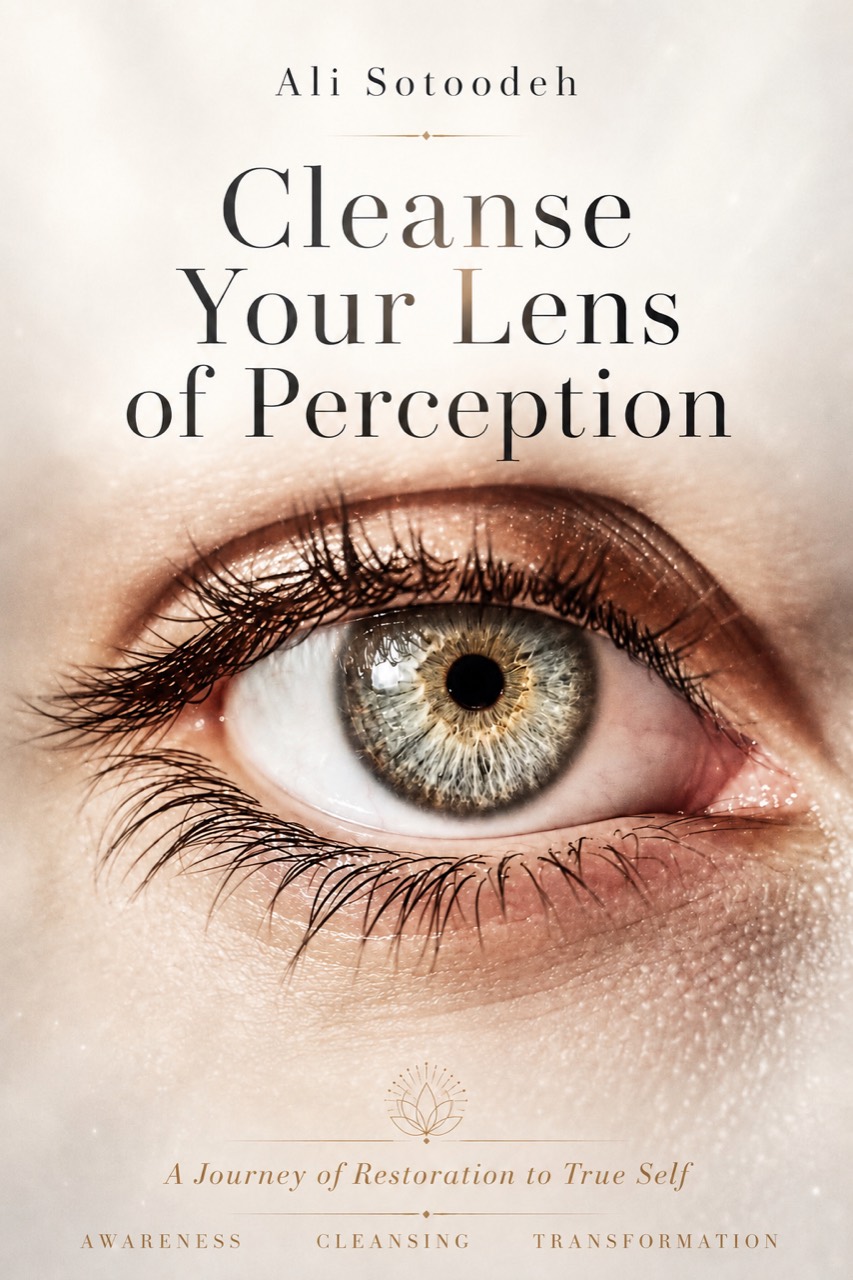
The future published book
Cleanse Your Lens of Perception is the full-length book—the central journey through Awareness, Cleansing, and Transformation. It is a separate product from the Interactive Workbook.
Be part of the journey
Choose the kind of book update you want. A single sign-up form will allow readers to request early-reader consideration, publication notices, or both.
Join the pool of readers who may be invited to read selected material and share thoughtful feedback as the manuscript develops.
Receive the release announcement, official purchase links, available formats, and related launch information.
Choose what you want to receive. Your request stays separate from the Interactive Workbook and client portal.
Inside the journey
The book moves through the ACT framework in three intentional movements: first seeing the lens, then clearing what distorts it, and finally learning to live through greater clarity.
Scroll to bring each chapter into focus. The image, title, and progress marker move with you through the journey.

The journey begins with a startling possibility: what you experience is not reality arriving untouched, but reality interpreted through a living inner lens. This chapter introduces the Current Reality Filter and explores how Story, Mindset, Energy, and Focus work together to select, organize, and give meaning to what you notice.
Rather than blaming you for the reality you have known, the chapter helps you separate an event from the meaning your lens learned to place upon it. That distinction creates the first opening for awareness—because a lens that can be seen can also be questioned, understood, and eventually cleansed.

Beliefs do far more than describe the world; they help the subconscious predict it. This chapter examines how conclusions formed through family, culture, repetition, emotion, and early experience become internal instructions that influence attention, identity, behavior, and what feels possible.
You will learn why an old belief can continue operating even when the conscious mind disagrees with it, and why recognizing a belief is not the same as proving it true. The aim is to bring hidden programming into awareness with enough curiosity and compassion that choice can begin to replace automatic obedience.

Trauma is explored here not as evidence that you are broken, but as the body’s intelligent attempt to survive what once exceeded its capacity. The chapter follows the ways unfinished survival responses can shape sensation, attention, memory, relationship, and the nervous system’s predictions about safety.
By understanding the body’s role, reactions that once appeared irrational begin to make sense as adaptation. The chapter establishes a respectful foundation for deeper work: safety before intensity, regulation before excavation, and compassion for the nervous system that learned to protect you.

Every person contains an inner cast: the achiever, protector, critic, caretaker, rebel, frightened child, and other roles formed to help life remain manageable. This chapter explores fragmentation, the false self, and the ways protective parts can take over the lens when they believe something important is at risk.
The goal is not to eliminate these parts or declare war on them. It is to meet the protective intelligence beneath their behavior and begin restoring inner leadership, so the deeper Self can relate to the whole system with curiosity, steadiness, and direction.

Emotions are the dashboard of the inner system. This chapter reframes anger, sadness, fear, shame, anxiety, and other emotional states as information about needs, predictions, boundaries, meaning, and perceived danger—not as proof of weakness or personal failure.
Anxiety is examined as a protective alarm that may be responding to the future imagined by the lens. Learning to listen without automatically obeying the alarm makes room for a more skillful response: one that honors the message, checks the present, and restores choice.

Human experience is not only a collection of thoughts; it is also felt as vitality, contraction, openness, heaviness, charge, flow, and presence. This chapter explores the energetic dimension of the lens and how inner state can influence perception before the conscious mind has named what is happening.
The discussion brings together embodied awareness, symbolic energy, and the connection between mind, body, and spirit without using spirituality to bypass pain. Its purpose is to help you sense the state from which you are meeting life—and recognize that restoration includes more than changing a thought.

Relationships reveal the lens in motion. This chapter explores how attachment, expectation, old wounds, protective roles, and nervous-system responses shape what we hear, fear, pursue, avoid, and assume in connection with other people.
The mirror is never presented as a reason to blame yourself for another person’s behavior. Instead, it becomes a place for pattern recognition, boundaries, accountability, co-regulation, and repair—showing where the past is entering the present and where a different relationship may become possible.

Cleansing begins with capacity. This chapter explains why the nervous system must experience enough safety and stability before deeper beliefs, emotions, or memories can be approached without turning growth into another form of overwhelm.
Through the principles of regulation, grounding, breath, orientation, and the window of tolerance, the reader learns to recognize activation and return to the present. Regulation is not avoidance; it is the foundation that makes honest clearing possible and sustainable.

This chapter develops the Observer: the awareness capable of noticing a thought, feeling, urge, or inner role without becoming identical to it. It explores resistance, surrender, and the power of returning attention to what is actually happening now rather than only to the story about it.
The Observer is not emotional distance or spiritual escape. It is a compassionate position from which experience can be witnessed clearly enough for choice to reappear—creating space between what arises and what happens next.

The inner cast introduced earlier is now approached directly. This chapter examines the protectors, exiles, shadow material, inherited roles, and survival strategies that can pull the system in conflicting directions while each part believes it is helping.
Healing comes through relationship rather than domination. By listening for protective intention, separating a part from the burden it carries, and restoring leadership to the deeper Self, the inner system can move from conflict toward integration.

Emotional charge often gathers around a conclusion: what an experience meant about you, other people, safety, worth, love, or the future. This chapter traces the relationship between body sensation, emotion, belief, and the repeated reality produced when the old conclusion remains unquestioned.
Cleansing does not mean suppressing an emotion or replacing it with forced positivity. It means allowing what is present to be witnessed honestly, finding the belief beneath the charge, and making room for a more complete truth.

Some experiences remain not only as stories but as residue—contraction, depletion, numbness, pressure, or a repeated disturbance in how energy is felt and organized. This chapter explores the chakra system and energetic awareness as ways of locating where lived experience may still be held.
Energetic work is connected back to the body, emotion, belief, and present-day choice so it does not become bypassing. The aim is alignment: helping thought, sensation, meaning, and intention move in the same direction.

Relationships can activate entire inner systems. This chapter shows how one person’s protector may meet another person’s wound, how familiar roles repeat themselves, and how a present disagreement can suddenly carry the emotional weight of the past.
The work moves beyond recognizing the pattern into accountability, boundaries, communication, co-regulation, and repair. The goal is neither self-abandonment nor blame, but the capacity to remain connected to yourself while meeting another person more truthfully.

Like a plant that continues returning when only its surface is cut, a pattern persists when its root remains untouched. This chapter follows recurring reactions from present-day behavior toward the earlier meaning, need, or belief that continues feeding them.
Reaching the root is not an invitation to live indefinitely in the past. It is a way to understand what the pattern has been protecting, loosen the shame attached to it, and prepare cleared ground where a new identity can take hold.

Transformation begins in a space so small it is often missed: the pause between stimulus and response. This chapter explores what becomes possible when an automatic pattern is interrupted long enough for awareness, regulation, and intention to enter.
That pause is where the reader begins moving from a life organized by old protection toward a life shaped through conscious authorship. Freedom is presented not as total control, but as a growing capacity to participate in what happens next.

Once the lens is no longer directed only by survival, it needs a conscious destination. This chapter explores values, desire, vision, meaning, and purpose as coordinates that help attention and action organize around the life you intend to build.
The destination is not a fantasy self used to reject who you are today. It is an embodied direction—clear enough to guide decisions, flexible enough to evolve, and meaningful enough to sustain action when novelty disappears.

Insight can reveal a new direction, but repetition teaches the nervous system that the direction is real. This chapter examines how identity, attention, rehearsal, behavior, and evidence work together until a new way of being becomes more familiar to the body.
Transformation is built through experiences the system can believe—not declarations it cannot yet trust. Small acts of congruence gradually become proof that the future self is not an idea being chased, but an identity being practiced into safety.

A restored life requires structure. Using the architecture of self, this chapter explores unconditional worth as the ground, values as the foundation, boundaries as protective walls, and lived safety as the roof beneath which identity can develop.
The reader is invited to build self-respect through estimable action rather than endless self-evaluation. Confidence, belonging, and authenticity become qualities supported by an inner structure—not performances maintained for approval.

The inner system does not need another tyrant; it needs trustworthy leadership. This chapter develops the image of the maestro—the Self who can listen to every part, understand competing needs, and still provide direction for the whole.
Leadership means becoming intentional about which voice holds the baton. As protective parts become heard and unburdened, the person can step into a role that was built deliberately: guiding the inner cast through relationship, accountability, and care.

Conscious creation is not magical control over every event. It is the decision to participate fully in the life available now—directing attention, energy, choice, discipline, and action toward what makes the restored self more real.
This chapter connects aliveness with practice: gathering small victories, responding from the person you are becoming, and releasing the demand for perfection. The work continues as you are clearing and healing; progress is evidence of participation, not proof that the journey is finished.

The final chapter turns from transformation toward wisdom. Sophia represents the understanding that awakening is not a finish line but a new relationship with the spiral—one in which familiar material may return at a deeper level and be met with greater honesty.
The journey closes by bringing awareness, cleansing, and transformation into an ongoing way of living. Wisdom appears through humility, service, discernment, and the willingness to keep tending the lens while sharing more of your light with the world.
When the book is published
Purchase from the official website when direct print or downloadable editions are available.
The official Amazon listing will be linked from this page once publication and distribution are complete.
Additional booksellers, digital formats, and selected distribution channels can be added as they are confirmed.
The Interactive Workbook is a separate protected experience where the chapter journeys, worksheets, workshops, and guided practices are organized for members.